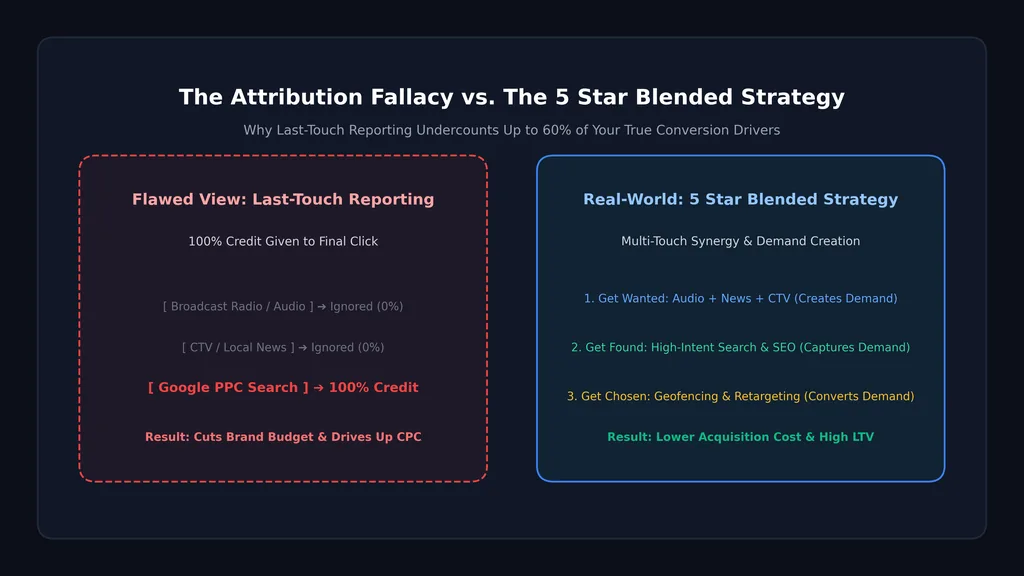
In modern digital marketing, business owners and marketing executives routinely rely on standard analytics dashboards—such as Google Analytics 4 or ad platform reporting—to decide where to allocate ad dollars. However, default analytics settings almost universally rely on last-touch (or last-click) attribution, assigning 100% of the conversion credit to the very final touchpoint a user clicked before completing a purchase or booking a call.
While last-click measurement feels clean and easy to track, it creates a dangerous strategic blind spot. By over-crediting final-step search ads and direct visits while ignoring every brand interaction that created the initial demand, last-touch attribution undercounts top-and-mid-funnel channels by up to 60%. Over-indexing on last-touch data causes business owners to systematically slash top-of-funnel brand building, sending customer acquisition costs (CAC) spiraling upward over time.
What Recent Industry Data Reveals About Attribution Bias
When evaluating marketing effectiveness across multi-channel campaigns, research from leading industry bodies highlights the flaw of single-touch measurement:
- Top-Funnel Undercounting: Studies by the Interactive Advertising Bureau (IAB) and Nielsen's Multi-Touch Attribution Benchmarks show that last-click models undervalue upper-funnel media (such as broadcast audio, local news display, and video) by 45% to 60%. These channels create the initial awareness that prompts a future brand search.
- Rising Keyword Bidding Wars: Benchmark reports from WordStream and Search Engine Land show that relying exclusively on bottom-funnel Google Search PPC drives up cost-per-click (CPC) by 20% to 35% annually as competitors bid against each other for a static pool of active searchers.
- The Halo Effect of Multi-Touch Exposure: Harvard Business Review marketing effectiveness research confirms that prospective buyers exposed to a combination of high-trust local media and digital search convert at a 3.5x higher rate than prospects exposed to search ads alone.
"When you only measure the final click, you are giving all the credit to the cashier while ignoring the sales rep who spent two hours helping the customer choose the product."
The Blended Strategy Framework: Moving Beyond Last-Click
In my strategy work with business owners, I apply Five Star Media Group's Blended Marketing Strategy / Omni-Channel Growth framework to balance brand-building with conversion capture across three distinct stages:
1. Get Wanted (Creating Demand & Brand Preference)
Before a customer searches for your services on Google, they must know your brand exists and trust your reputation. The "Get Wanted" phase builds broad community reach using local broadcast audio frequency and trusted local news authority like ClarksvilleNow.com. Although radio listeners and news readers rarely click an ad instantly while driving or reading, this top-of-funnel presence builds lasting recall—driving future organic and branded search volume at a fraction of the cost.
2. Get Found (Capturing Active Intent)
Once upper-funnel reach establishes brand trust, the "Get Found" phase captures prospective buyers at the exact moment of search. Through strategic Google PPC management, local keyword optimization, and Google Business Profile management, your brand dominates high-intent search results. Because upper-funnel campaigns have already built familiarity, your search ads achieve significantly higher click-through rates (CTR) and lower cost-per-lead (CPL).
3. Get Chosen (Multi-Touch Re-engagement)
Rarely does a high-value customer purchase on their first website visit. The "Get Chosen" phase deploys hyper-local geofencing, targeted display ads (TDA), OTT/CTV video, and first-party retargeting. By maintaining multi-touch visibility across mobile devices while prospects compare options, you guide qualified leads seamlessly to final conversion.
3 Actionable Steps to Fix Your Attribution Model Today
- Compare Branded vs. Non-Branded Campaign ROAS: Measure the conversion cost of branded search keywords against generic category keywords. If generic keywords are getting more budget but delivering higher CAC, your top-of-funnel demand creation needs boosting.
- Implement Multi-Touch & Blended CAC Metrics: Track Blended Customer Acquisition Cost (Total Marketing Spend ÷ Total New Customers) rather than evaluating each ad channel in isolation.
- Audit Upper-Funnel Assisted Conversions: Check GA4's Attribution Paths and Assisted Conversions reports to identify channels that initiate buyer journeys but rarely receive last-click credit.
Ready to Build a High-Return Growth Engine?
If you want to eliminate ad spend waste and build an accurate, profit-focused attribution strategy, contact me today to schedule a personalized Client Needs Analysis (CNA) and Media Diagnostic.